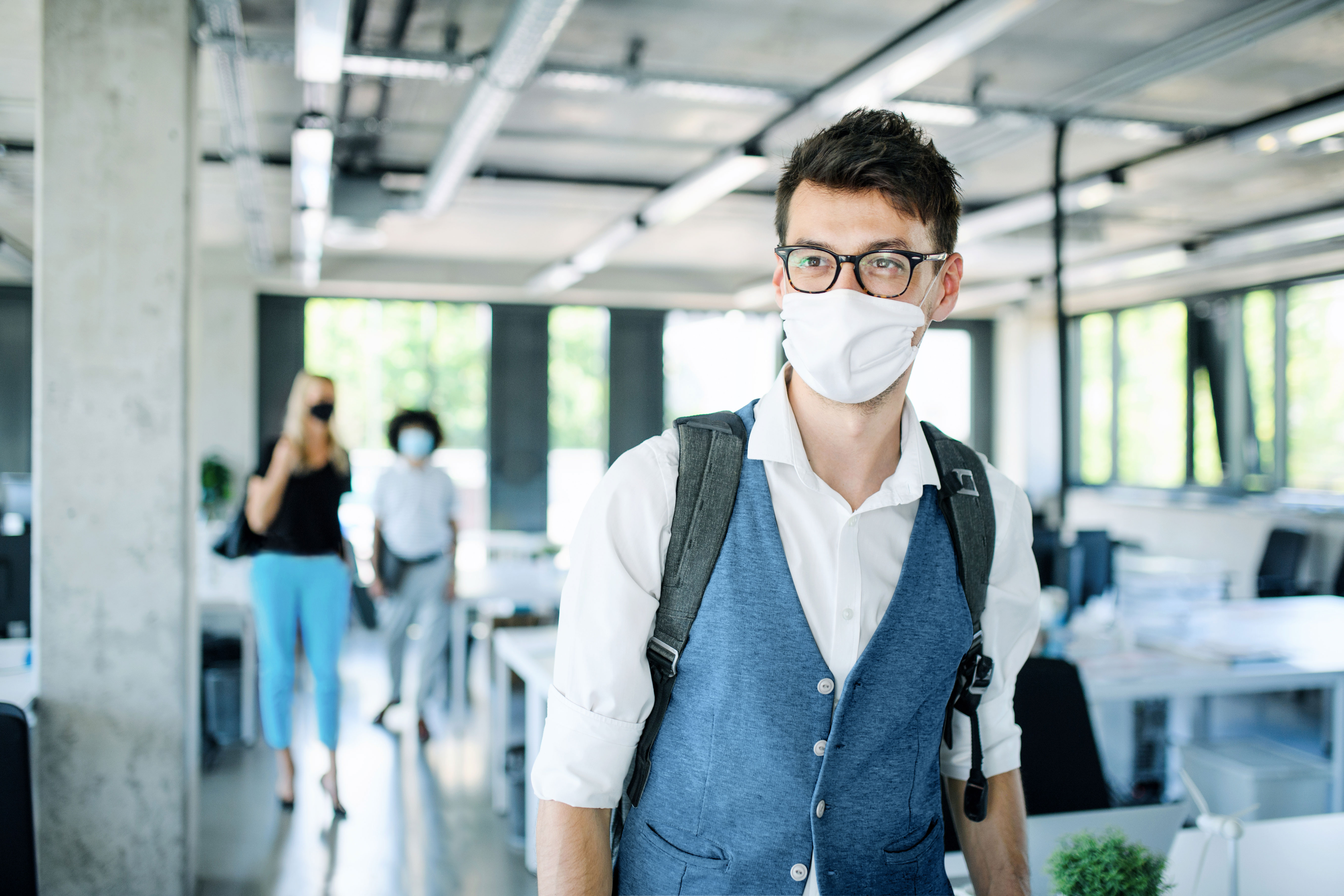
An internal mask wearing test has impressively proven the effectiveness of the Sanitized® hygiene function on community masks. Microbiological tests show that an untreated mask holds up to more than three times as much bacteria as a treated mask. SANITIZED AG uses particle-free technologies and values sustainability.
Nowadays, many different types of masks have become part of our daily lives. Some people prefer disposable masks, while others feel that FFP2 or N95 masks afford them special protection. Some have opted for textile masks (community masks) as a more sustainable and comfortable alternative. No matter which type of mask we use every day, their purpose goes beyond protection. At the same time, it is a fashion accessory, conversation starter, a heat source, a thorn in your side, a way to hide your emotions, or a canvas for expressing your own personality. One way or another, all masks eventually become an ideal home for microorganisms. The heat, moisture, and the skin and hair residues in our masks allow bacteria to rapidly reproduce and cause bad odors.
Twelve test subjects wear treated and untreated masks
How much bacteria settles in a mask after being worn for an hour? What are the numbers after four hours? It’s time that we answer these questions, and twelve SANITIZED AG employees have conducted a wearing test to give us definitive answers. Employees wore standard textile masks made of 100 % cotton for one, two, three, and four hours during their normal workday. Afterwards, the microbiology team examined the masks and recorded the bacterial levels. Six women and six men between 20 and 64 years of age participated in the wearing test. They either work in the laboratory, in the office, or in process engineering.
It was teeming with microbes after four hours
There was a sharp, linear increase in the amount of bacteria on the masks. The microbiology team detected an average of 15,000 cfu/g on the untreated mask after they were worn for an hour. The unit “cfu/g” represents the number of colony-forming units per gram of textile, i.e., the number of bacteria per gram of textile with the ability to reproduce.
The microbiology team has taken additional measures to demonstrate the corresponding “contamination” of a mask during an average of half a workday with a subsequent one-hour lunch break. After being worn for four hours, the measurements showed that the textile had 70,000 cfu/g. The measurement after the lunch break was even more impressive: The number of bacteria had steadily and linearly increased to 85,000 cfu/g during the one-hour break. Bacteria had proliferated on the mask to such an extent that substantially more bacteria were detected in a gram of the mask’s textile than on a toilet bowl.
Clearly proven hygiene function
In the second part of the wearing test, employees wore the same type of textile masks again. However, these masks were treated with the Sanitized® antimicrobial technology. The differences are amazing: After being worn for four hours, the treated mask had only 35,000 cfu/g. Bacteria levels were half of what the untreated mask had. This result already proves how significantly effective the Sanitized® hygiene function is. But if the treated mask is not worn for an hour during a lunch break, bacteria levels fall below 30,000 cfu/g. Compared to the treated mask, the untreated mask thus shows more than three times as much microbes per gram of mask after the lunch break. A clear victory for the treated mask! We are proud of the results of the mask wearing trial. Although this is not a scientific study, we have proven the Sanitized® hygiene function under real-world conditions. Furthermore, the employees have confirmed that the mask still feels fresh and comfortable after being worn and does not smell unpleasant.
SANITIZED AG relies on reusable and particle-free technology
We have already been able to successfully implement many projects in collaboration with our customers. Based on our experience, customers value reusable textile masks, especially when you think about how much waste accumulates around the world due to disposable masks. The sad reality: Many masks end up in the world’s oceans. According to media reports, more than 1000 masks have washed ashore on the remote Australian island of Lord Howe over the past six months. The island is located over 500 kilometers away from the Australian mainland. > Read article
The Sanitized® quality seal gives you a sense of safety. Whether during processing, for environmental reasons, or when used with consumers, SANITIZED and their customers are committed to reasonable use of premium antimicrobial additives. This also means that we do not use any particle-based technology, since we still do not know the effects of these nanoparticles on humans and the environment. > Read blog «Protection against COVID-19: Which antiviral advertising claims are legal? SANITIZED explains.»
In the «Mask Wearing Trial for Community Masks» whitepaper, you can find detailed information on the mask wearing test and tips on how to properly use facemasks.